Need help?

Key Stages of M&A

Published on Jul 17, 2026

A step‑by‑step guide to the mergers and acquisitions lifecycle, from strategy and target screening through valuation, due diligence, signing, closing, and post‑merger integration.
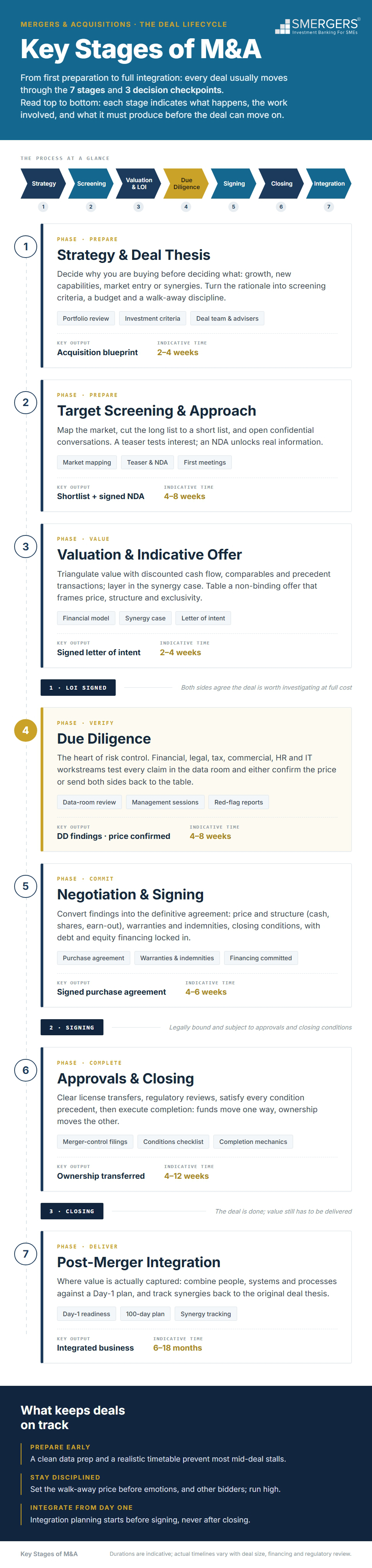
Every deal moves through the seven stages, with three decision checkpoints where both sides agree whether to continue. Read from top to bottom: each stage describes what happens, the work involved, the deliverable that must be produced before advancing, and how long it typically takes. Timelines are indicative; real durations shift with deal size, financing requirements, and regulatory review.

1. Strategy & Deal Thesis - Phase: Prepare

Before selecting a target, define the acquisition thesis. Decide whether the deal serves growth, new capabilities, market entry, or operational synergies. Convert that rationale into concrete screening criteria, set a budget, and establish a disciplined walk-away price so emotions or competing bidders do not inflate the deal later. This stage produces the acquisition blueprint, the strategic document that guides every decision that follows.

Key Output: Acquisition blueprint

Indicative Time: 2-4 weeks (shorter for focused strategic pivots; longer if portfolio review spans multiple business units)

Checkpoint 1: LOI Signed. Both sides formally agree the deal is worth investigating at full cost before committing to deeper diligence and expense.

2. Target Screening & Approach - Phase: Prepare

Map the competitive landscape, build a long list, then narrow it to a credible short list through confidential outreach. A teaser document tests buyer interest without disclosing identity; once interest is confirmed, an NDA unlocks real financial and operational information. The stage ends when a shortlist exists and key targets have signed NDAs, opening the door to structured evaluation.

Key Output: Shortlist + signed NDA

Indicative Time: 4-8 weeks (market mapping can run faster in consolidated industries; slower in fragmented sectors with many potential targets)

3. Valuation & Indicative Offer - Phase: Value

Triangulate value using multiple methods: discounted cash flow projections, comparable public-company trading multiples, and precedent transaction analysis. Layer in a synergy case (cost savings, revenue uplift, or strategic premium) to justify a price above standalone value. Package the result into a non-binding letter of intent that frames price, deal structure (cash, shares, earn-out), and exclusivity, giving both sides a common framework without legal obligation.

Key Output: Signed letter of intent

Indicative Time: 2-4 weeks (complex capital structures or cross-border tax considerations may extend this)

Checkpoint 2: Signing. Legally binding purchase agreement executed; the deal is subject to regulatory approvals, financing conditions, and other closing prerequisites.

4. Due Diligence - Phase: Verify

This is the core risk-control stage. Dedicated workstreams covering financial, legal, tax, commercial, HR, and IT matters examine every claim in the data room. Management sessions, site visits, and red-flag reports either confirm the valuation assumptions or reveal gaps that require price adjustments, warranty terms, or renegotiation. The stage is complete only when findings are documented and the price is either confirmed or revised with mutual agreement.

Key Output: DD findings, price confirmed (or renegotiated)

Indicative Time: 4-8 weeks (larger targets or highly regulated industries often require the full 8 weeks or more)

5. Negotiation & Signing - Phase: Commit

Translate due-diligence findings into the definitive agreement. Lock in price and structure (cash, equity, earn-out mechanisms) and define warranties, indemnities, and closing conditions that allocate risk between buyer and seller. At the same time, secure committed debt and equity financing so capital is available at closing. Once signed, both parties are legally bound to complete the transaction subject only to the conditions listed in the agreement.

Key Output: Signed purchase agreement

Indicative Time: 4-6 weeks (parallel financing negotiations can extend this if debt markets are volatile)

6. Approvals & Closing - Phase: Complete

Satisfy every closing condition: file merger-control applications with regulators, secure license and contract transfers, complete third-party consent processes, and resolve any remaining prerequisites. Once all conditions are met, execute completion: funds transfer, ownership passes, and the transaction closes. The deal is now legally complete; delivering its value is the work of the next stage.

Key Output: Ownership transferred (legal closing)

Indicative Time: 4-12 weeks (regulatory reviews, especially in multi- jurisdiction deals, are the primary variable)

Checkpoint 3: Closing. The transaction is complete and ownership has changed hands; the remaining work is to realize the strategic value promised in the acquisition blueprint.

7. Post-Merger Integration - Phase: Deliver

Value is captured during integration, which is why this stage gets the most time. Combine people, systems, and processes against a Day-1 readiness plan that was developed before signing. A 100-day plan sets immediate priorities; longer-term synergy tracking links results back to the original deal thesis. Integration is continuous, typically six months to a year and a half, and requires the same discipline applied during the deal itself.

Key Output: Integrated business (operational and strategic value realized)

Indicative Time: 6-18 months (cultural integration and IT consolidation often extend timelines beyond initial estimates)

Three principles that keep deals on track:

- Prepare Early: A clean data room, realistic timetable, and clearly defined outputs prevent most mid-deal stalls and renegotiations.

- Stay Disciplined: Set the walk-away price before emotions and competitive dynamics inflate it; maintain the discipline established in the strategy stage.

- Integrate From Day One: Integration planning must begin before signing, not after closing; the Day-1 plan should be approved before the deal closes.

Durations are indicative. Actual timelines vary with deal size, financing complexity, and the scope of regulatory review required in the jurisdictions involved.


Share this on social media
📈  Industry Watch

Automobile industry facing a tough time as vehicle demand is sluggish. Valuations of companies on the lower end. Autocomponent industry is also expected to witness a flat growth this fiscal because of weak automobile demand. The industry will remain under pressure in the near future because of the high inventory levels with dealers.


Fitness industry in India is worth Rs.4,500 crore and is growing at 16-18% annually and is expected to cross Rs.7,000 crore by 2017. The industry is fragmented with majority of the market dominated by unorganized and independent gyms outlets. The organized or modern fitness retail is around 28% currently but growing a 22-27% yearly growth rate. There are over 21,000 health and wellness centers across India as of 2014.
Low utilization rates and weak demand from realty and infrastructure sectors is driving consolidation in the Indian cement industry. More mergers & acquisitions are expected in the medium-to-long-term as valuations are attractive to buyers and investors. India is the second largest producer of cement in the world.
Demand for electronics hardware in India is projected to grow at 25% compared to only 15% growth in production, expected to create a demand supply gap of Rs.14.8 lakh crores by FY20. This creates a unique opportunity for electronics companies looking at India as their next manufacturing hub with a large domestic demand.
The ecommerce space in India is still evolving and companies have limited history. Many of them function at negative operating cashflows and are dependent on investments from venture capital firms. Using traditional valuation methods like DCF Valuation and Relative Valuation remain a challenge in this segment. While each company needs to be examined individually, this reckoner presents a broad guideline of a dual framework to value ecommerce companies with illustrative examples.
The food processing industry in India is getting a shot in the arm with increased focus from the government and policy makers, higher involvement of scientists to help increase food processing productivity, and establishment of mega food parks across the country.
The Staffing Industry includes companies which list employment vacancies, place applicants in employment, supply temporary workforce and all other employment related services. Market size of the Indian staffing industry was INR 26,650 crore in 2014 and is growing between 10-15% year on year.
Global acquisitions by Indian IT firms rising with a majority of the transactions happening in Europe and North America. Primary reasons driving these acquisitions are increasing local presence in the US and Europe, acquiring employees with a specific skill set, and strengthening their capability in a particular segment.
The Indian healthcare market is expected to reach ₹ 24 lakh crore by 2022 from ₹ 9 lakh crore in 2016 growing at a CAGR of 17.7% driven by rising incomes, greater awareness, prevalence of lifestyle diseases and increasing penetration of medical insurance.
Nutraceuticals (also called health supplements) are specially processed or formulated foods designed to satisfy particular dietary requirements and/or provide medicinal or health benefits. They generally contain extracts from plant & animal sources, minerals, vitamins and dietary substances either discretely or in various combinations designed to meet a specific health requirement or augment nutritional intake.
The Apparel industry or the Ready-Made Garments (RMG) Industry is the largest segment of the Indian Textiles and Apparel (T&A) Industry accounting for approximately 50% of the total industry. Given that apparel manufacturing is economically viable at any scale, the industry is characterized by several small participants and is dominated by the unorganized segment.
Facility Management (FM) refers to the use of a third-party service providers to maintain a part or entire building facility in a professional manner. It is increasingly gaining popularity amongst commercial as well as residential clients driven by modernization, rapid urban development and a growing awareness of advantages arising from outsourcing non-core business activities.
Fuel additives are fuel-soluble chemicals added in small quantities to enhance the properties of the fuel, improve fuel handling and fuel performance. The rapidly increasing demand for hydrocarbon fuels from transportation and power industries have led to the development of a large range of fuel additives to meet industry requirements.
The worldwide ERP software grew by 6.4% in 2014 to reach $27B market size. The segment is anticipated to garner $41 billion in sales by 2020 with a CAGR of 7.2% during 2014-2020. ERP software is second fastest growing segments within Enterprise Software after CRM. ERP market is a multibillion-dollar industry that produces components that support a variety of business functions. ERP Investments have become the largest category of capital expenditure in United States-based businesses over the
Advertising spends in India are expected to grow 12.6% year on year to Rs 48,977 crore for the year 2015. The ad spend in 2014 was Rs. 43,490 crore, which reflected a 12.5% increase over 2013. Firms in the advertising industry prepare advertisements for other organisations and design campaigns to promote the interests and image of their clients.
It is widely believed that India has not fully leveraged its strength in the Manufacturing sector in the last decade, but the sector is expected to emerge stronger in next decade as companies innovate and adopt new business models. To support this growth, the government needs to play its role in providing better infrastructure, policies, regulations, duties and taxes.
Pharmaceutical industry seems to be entering a growth phase after a muted growth over the last few quarters. Valuations of pharma companies fairly high as they are expected to perform. Indian Pharmaceuticals industry is the world’s third largest in terms of volume.
The Indian restaurant industry is highly unorganized and fragmented but is getting rapidly organized with Quick Service Restaurant (QSR) segment leading the way. Private Equity and Venture Capital firms have shown increased interest in this sector to capitalize on India's consumption boom.
The salon industry in India is largely unorganized but is getting organized at a fast pace. The average per person spending on salons in India is a minuscule of spending in other locations such as North America, Europe, and Asia. Even a small growth in this spending provides a huge opportunity for organized players in this sector.
India is world’s second largest producer of textile and apparel after China. China is slowly reducing its focus on textiles and this has had a positive impact on the Indian textile and apparel industry. But not everything in the garden is rosy as Bangladesh, Vietnam and Turkey’s emerging textile industries are capturing a large portion of the global demand.
Indian organic market size: INR 16,800 crore (2023). With India’s inherited tradition of natural farming, coupled with strong agricultural diversity, the country is positioning itself as a major global player in organic production and exports.
The Indian AYUSH and Ayurveda industry is booming! AYUSH: Ayurveda, Yoga, Naturopathy, Unani, Siddha, Sowa-Rigpa, Homoeopathy. Growth: Manufacturing sector hit INR 2 lakh crores (US$ 24B) by 2024. Total industry worth INR 4.1 lakh crores (US$ 50B) in 2024, projected to reach INR 5.8 lakh crores (US$ 70B) by 2025. Ayurvedic Market: Expected to grow to INR 3.2 lakh crores (US$ 38.28B) by 2032. COVID-19 Impact: Boosted demand for natural immunity-enhancing products. Consumer Trends: 77% of
The Indian water and wastewater treatment industry is growing due to rising water scarcity, rapid urbanization, government infrastructure spending, and stricter wastewater regulations. India is emerging as a major market for water recycling, sewage treatment, ZLD systems, and smart water management solutions.
The global ice manufacturing industry is witnessing steady growth driven by rising beverage consumption, expansion of foodservice and hospitality sectors, and increasing cold-chain requirements. India is emerging as a high-growth market, supported by rising temperatures, growing demand from fisheries and logistics, and rapid expansion of organized cold-chain infrastructure.
The Indian spirits market is expanding with rising disposable incomes, rapid urbanization, and shifting cultural trends. Whisky dominates consumption, while rum and white spirits show strong growth potential. India remains one of the world’s largest alcoholic beverage markets, attracting global players and steady investment activity
Indian managed farmland industry provides a lucrative passive investment opportunity. Managed farmland lets investors own farm plots while companies handle operations, sharing profits from produce sales. With India's 159.7M hectares of arable land and a 30% capital appreciation rate, farmland is emerging as a top passive income asset. Land ownership laws vary by state, with prices averaging ₹67.5L/acre, peaking at ₹93L in Karnataka. As demand grows, farmland investing is set to soar.
Fueled by innovation, aging populations, and chronic illnesses, the market is set to reach USD 863.2B by 2030. With segments like diagnostic imaging, cardiovascular, and dental devices, this sector spans essential healthcare tools. The USA leads globally (USD 256.2B in 2024), while India and China show rising demand. Expect intense competition, moderate customer power, and high entry barriers. With low supplier influence and tech advancements, this industry is poised for explosive growth.
The $193B global gaming industry is evolving fast — not just play, but earn. Gamers are creators, streamers, and income earners, with Web3 and NFTs unlocking asset ownership and digital economies. By 2025, the industry hits $211B, driven by mobile gaming ($116B). From play-to-earn to metaverse concerts and user-generated content, gaming is reshaping entertainment, finance, and social engagement. India is a global leader in NFT gaming adoption, and Web3 games are poised to dominate with
The global toy industry is booming, expected to surpass $120B by 2023! Europe is the 3rd largest market, with 99% of manufacturers being SMEs. Offline sales still lead, but online channels are growing fast. Innovation, regional demand, and small-scale producers are shaping the future of play!
The global MICE industry is expanding due to recovering corporate travel, hybrid event adoption, and rising convention infrastructure investments. Indonesia is emerging as a key Southeast Asian MICE destination, driven by tourism growth, government support, and increasing international business events.
Global oil demand is rebounding post-pandemic, driven by transport and industrial fuel needs, while Slovakia’s fuel retail market modernizes through automation and strong independent players. Our latest Industry Watch dives into trends, recovery timelines, and the future of fossil fuels vs automation in fuel retail.
The global robotic mower industry is booming! Market Size: Valued at USD 1.5 billion (EUR 1.36 billion) in 2021, expected to reach USD 3.9 billion (EUR 3.56 billion) by 2027 at a CAGR of 12%. Western Europe: Leading the market with consumers switching from gasoline-powered mowers to smart, efficient, battery-powered robotic mowers. Golf Industry: Demand for commercial lawn mowing equipment is driven by aging infrastructure and a resurgence in golf. Technological Advancements:
The global e-commerce market is expected to grow from $16.6 trillion in 2022 to $70.9 trillion by 2028. Key players like Shopify are driving this growth, while M&A activity, including seed funding for apps like Okendo, highlights the dynamic nature of the industry.
The global smoking accessories and cannabis industry is evolving! Market size (global smoking accessories): USD 64.4B in 2021, projected to grow at 4.0% CAGR till 2030. Trends: Shift from cigarettes to safer non-smoking products. Rise of tobacco-free oral nicotine. Drivers: High demand for water pipes and vaporizers. Online retail platforms leading the way. Key Markets: Germany: Largest cannabis market in Europe, plans to legalize adult-use. Netherlands: Tolerates recreational cannabis
The global car carrier logistics industry is growing with rising EV demand, digital dispatch tech, and cross-border trade. Bulgaria, Europe, and Asia-Pacific emerge as key automotive logistics hubs.
Unlock investment opportunities in Malaysia's lightning protection industry! High Demand: Malaysia experiences extremely high lightning discharges, with cities like Bayan Lepas having 293 lightning days per annum. Critical Infrastructure: Over 70% of power outages in Malaysia are due to lightning, costing the nation over RM 250 million annually. Market Growth: The global lightning protection technology (LPT) market was valued at MYR 3.5 billion ($800 million) in FY 2020, with a CAGR of
The Malaysian playschool industry is on the rise! Market Growth: Expected to reach RM 19 billion by 2026, with a CAGR of 5.6% (2021-2026). Curriculum: Adheres to the National Preschool Curriculum, emphasizing play, thematic, integrated approach, and IT communication. Enrollment Trends: Private playschool enrollment has outpaced public rates since 2014. Importance: Early childhood experiences are crucial for brain development. Current Landscape: 16,700 government preschools and
Australia’s supermarket and online grocery industry is evolving fast, valued at AUD 113B and projected to hit AUD 129.6B by 2026. Post-COVID trends, digital adoption, and economic shifts are reshaping how Aussies shop. Discover insights into market drivers, consumer behavior, and the future of grocery in this industry report.
The global web development industry is growing with increasing digital transformation, AI-assisted development tools, and rising demand for online business presence. The United States remains a leading market, while emerging economies continue to drive growth through expanding internet usage and digital adoption.
The community management software is transforming customer engagement, brand advocacy, and support. Valued at AUD 13.33B (USD 8.32B) in 2023, this market is set to hit AUD 58.66B (USD 36.68B) by 2032, growing at 17.93% CAGR. Driven by remote work and virtual events, brands leverage SaaS, freemium, and ad models to enhance loyalty, gather feedback, and boost advocacy. Online communities are now a business essential!
The UAE fitness market, valued at AED 1.2 billion in 2023, is growing due to government support, digital fitness adoption, and rising health awareness. While traditional gyms face slight decline, virtual fitness platforms are expected to reach AED 1.03 billion by 2030. The sector shows high competition, moderate consumer power, and low supplier dependency. Leading gym brands include GymNation, Fitness First, and Gold’s Gym. Key trends include tech-enabled workouts, nutrition services, and
The UAE foodservice market is rapidly expanding, driven by growing consumer demand, diverse cuisines, and innovative restaurant technologies. With a projected CAGR of 17.10%, it’s set to reach AED 161.53 billion by 2029. Discover key insights on the booming restaurant tech sector, consumer trends, and Dubai's vibrant dining scene shaping the future of the industry.
Singapore’s construction industry faced a sharp 33.7% decline in 2020 due to COVID-19, labor shortages, and project delays. However, recovery is underway, led by public housing, healthcare, and infrastructure. With renewed investments and policy support, the sector is poised for resilient, sustainable growth in the years ahead.
Unlock the potential of the Greece furniture retail market! Market Growth: Expected to generate EUR 1.15B in 2023 with a CAGR of 2.45% until 2028. Key Segments: Bedroom, Living Room, Kitchen & Dining, Bathroom, Outdoor, Home Office. Global Position: Ranked 57th worldwide, with significant import reliance from India, Italy, Germany, Poland, and Turkey. Millennial Drivers: Millennials are fueling demand as they buy their first homes. Economic Boost: Greece’s economy is growing by 2.4% in
Revolutionizing healthcare in the U.S.! The telehealth market has surged with a CAGR of 28%, projected to hit $43 billion by 2026. Fueled by mobile technology, broadband connectivity, and increasing demand for safe, convenient care post-pandemic, telehealth is the future of healthcare. Psychiatry leads specialty adoption, while web/app platforms dominate delivery modes. Discover how telehealth is transforming access and innovation in modern medicine!
Dive into the world of themed fabrication! From crafting immersive experiences for theme parks to creating interactive museum exhibits, this industry blends engineering, artistic craftsmanship, and storytelling like no other. With booming sectors like retail, hospitality, and entertainment, the future is bright. Explore how advancements in technology and global tourism are shaping unique environments that captivate audiences!


Chat with Us
Welcome to SMERGERS