Owned vs Rented Facility: How It Actually Impacts Business Valuation
Walk into any SME valuation discussion and one will almost certainly hear an owner proudly say:
“My business should be worth more because I own the building.”
It sounds intuitive. Owning feels better than renting, not just financially but emotionally. Renting feels temporary, while ownership signals stability. But intuition is not valuation. When valuing a business, analysts, investment bankers, private equity firms, and public markets follow a simple but ironclad principle:
‘Asset or Not - Cashflow Is the Boss.’
This article aims to explain how ‘owning versus renting’ influences business valuation, supported by:
- Real public-company examples
- International Valuation Standards (IVS)
- IFRS rules
- Corporate finance logic
- Numerical tables and DCF models
- A simple decision-tree to classify property correctly (business asset v/s investment asset)
By the end, it should be evident why ownership only occasionally influences operating business value, and why renting often leaves that value virtually unchanged.
1. First Principles: What Is a Business Being Valued For?
A business is valued on:
- Cashflows it can generate
- Growth of those cashflows
- Risk attached to those cashflows
Everything else is commentary. Buildings, machinery, vehicles, land, these matter only to the extent that they affect (1), (2), or (3).
The mistake owners make is assuming: “If I don’t pay rent, my profits are higher i.e. my valuation is higher.”
This seems correct but collapses under valuation logic and industry practices. To see why, let’s begin with the most important distinction in real-world valuation.
2. An Important Concept: OpCo vs PropCo
In valuation, we can consider two entities:
OpCo (Operating Company)
– The business that produces revenue
– Valued using DCF or EBITDA multiples
PropCo (Property Company)
– The land/building used by the business
– Valued separately using real estate methods
This separation is fundamental and not optional.
Why? Because the business generates cashflows from customers and the building generates value from real estate economics (rent, appreciation).
They have different:
- risk profiles
- discount rates
- return expectations
- valuation methodologies
This distinction is codified in valuation standards: International Valuation Standards (IVS 103 and 200 )
The IVS 103 states: “In developing a discount rate, the valuer should consider: (a) the type of asset being valued. For example, discount rates used in valuing debt would be different to those used when valuing real property or a business.” ) 1
3. When Property is a Business Asset vs When It’s Not
Not all properties are treated the same. To decide whether the building belongs inside the operating valuation (OpCo) or should be valued separately (PropCo), valuers ask three questions.
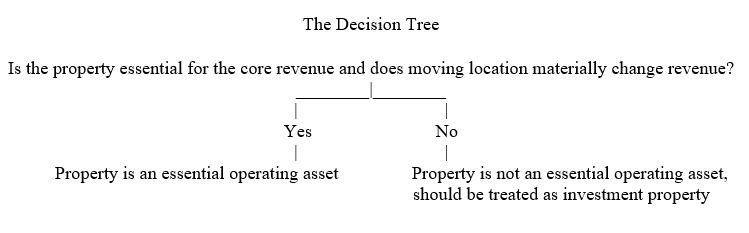
Next test:
Does the property have a different risk/return profile than the business?
If yes → Property must be valued separately.
If no → Can consider combined valuation.
Examples of operating property (belongs inside OpCo)
- Hospital building with ICUs, OTs, oxygen pipelines
- Specialized manufacturing plant (pharma, semiconductor fab, dairy plant)
- Cold storage warehouse with insulation and ammonia systems
- Refinery or power plant site
- Data center built for high power density
- Owned building with a restaurant in a high traffic location like Times Square, Champs De Elysees or Connaught Place
Here the property enables revenue directly.
Examples of non-operating property (should be PropCo)
- Retail shop location
- Office building for a consulting company
- The building where a small restaurant sits
- A warehouse that could be anywhere
- Clinic building that does not influence patient volume
Here the property does not generate revenue, only the business does.
4. Public-Company Proof: How Markets Treat Ownership vs Renting
To demonstrate this, let’s examine real public giants.
Example 1: Starbucks (Renter)

Starbucks leases almost all of its 38,000+ stores 2
Yet Starbucks trades at high valuation multiples because investors love its:
- asset-light structure
- high ROIC
- flexibility to relocate
- capital deployment into growth, not property
Owners who think renting hurts valuation need only see Starbucks.
Example 2: McDonald’s (Owner + Renter Hybrid)

With over 43,000 locations worldwide, 80% of which are owned by McDonald’s 3
But here’s the twist: McDonald’s property generates rental income from franchisees. The real estate is part of a PropCo revenue model, not an operating cost saver.
Analysts always separate:
- Restaurant operations (OpCo)
- Property rental business (PropCo)
Owning buildings doesn’t inflate operating valuation, the rental income does.
Fun fact: If McDonald’s were to spin off its real estate as a separate property rental business, it would be the largest REIT globally 4
Example 3: Marriott & Hilton (Asset-Light Movement)

When Marriott and Hilton shifted from owning hotels to focusing on brand, management, and franchise operations, the impact was noticeable. By freeing themselves from the capital-intensive burden of real estate ownership, both companies were able to expand faster, earn higher returns on the capital they retained, and present cleaner, more predictable cashflows to investors.
Public markets responded favourably. The companies’ valuation multiples improved over time because the asset-light structure allowed them to grow without tying up billions in property. In other words, investors preferred the strength of their operating models over the weight of their real estate portfolios.
Marriott’s asset-light transformation 5
Hilton’s similar restructuring 6
Why? Because markets reward high-return businesses, not buildings.
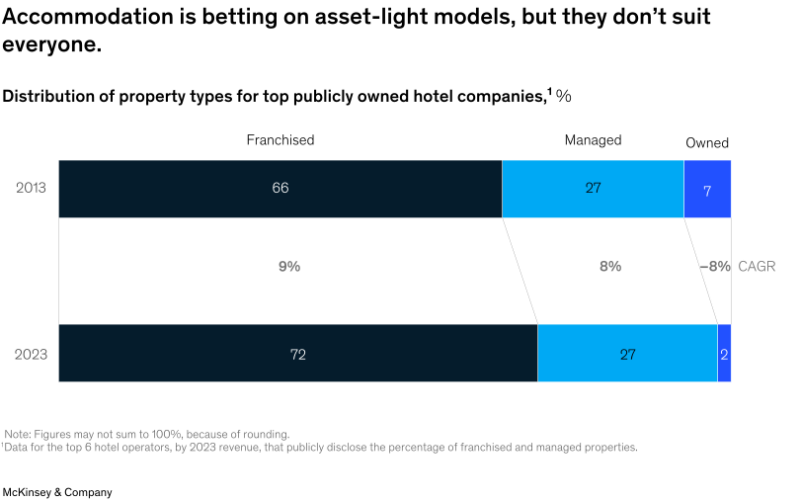
7
Example 4: AT &T Sale-and-Leaseback

In 2025, AT&T sold 74 buildings in an ~$850M deal and leased them back. 8
AT&T’s sale-and-leaseback of 74 properties is a useful illustration. By selling the buildings and leasing them back, AT&T released substantial capital that had been sitting passively in real estate. The market viewed this positively because it allowed the company to reduce debt and redirect funds toward its core business operations, where returns are typically higher than those generated by holding commercial property.
The episode demonstrated a consistent pattern in capital markets: investors often favour companies that deploy capital efficiently, even if it means transitioning from ownership to long-term leases.
Market reaction was positive, because investors prefer capital efficiency over ownership optics.
Example 5: Walmart & Target, Ownership Is Strategic, Not a Valuation Engine

Retailers like Walmart and Target operate a mix of owned and leased stores. However, analysts do not assign higher valuations to these businesses purely because they own portions of their real estate.
What matters far more is how effectively these companies run their operations, their supply chain strength, store productivity, pricing strategy, and customer reach. Real estate ownership is treated as a strategic decision, useful in certain locations, but not a core driver of operating value. As a result, their property portfolios are assessed separately from the valuation of the retail business itself.
5. The Core Question: “Why Put Imputed Rent in an Owner Valuation?”
Answer: If the business uses a building, it must bear the economic cost of that usage. So even if the owner inherited the building and pays $0 rent, the business is occupying space that could earn rent or could be sold. This foregone rent is called Imputed Rent. It is the rent the business should pay for a fair valuation, even if it doesn’t. This keeps the projected future cashflows realistic and fair.
Otherwise:
- EBITDA becomes artificially inflated
- FCFF becomes unrealistic
- Discount rate doesn’t match asset risk
- Competitors become incomparable
- The business appears more profitable than it is
This principle is also codified in valuation practice: IVS 200 and IVS 400 require valuers to match cashflows to risks, and not mix non-operating assets into operating cashflows. 1
6. Full Numerical Demonstration: Renter vs Owner
We will venture into technical territory and do a full numerical demonstration of a DCF and EBITDA multiple valuation of how to value a business.
Assumptions used:
- Revenue: $2 million
- EBITDA before rent: $500 thousand
- Market rent: $120 thousand
- Machinery depreciation: $50 thousand
- Machinery capex: $50 thousand/year
- Working capital increase: $20 thousand/year
- Tax rate: 25% (Federal + State)
- WACC: 11.5%
- Terminal growth: 2.5%
A. P&L Comparison
| P &L Item | Renter | Owner |
|---|---|---|
Revenue |
2,000,000 |
2,000,000 |
EBITDA before rent |
500,000 |
500,000 |
Rent + Maintenance (actual / imputed) |
–120,000 |
–120,000 |
| EBITDA for valuation | 380,000 | 380,000 |
EBITDA is equalized because imputed rent is added to owner.
B. Capex & Net Block (What goes into OpCo)
| Capex Item | Renter | Owner |
|---|---|---|
Machinery capex |
50,000 |
50,000 |
Building capex |
Not included |
Not included |
Building net block |
Not included |
Not included |
Depreciation (machinery) |
included |
included |
Because the building is not an operating asset unless classified as essential.
C. Balance Sheet (OpCo Only)
| Item | Renter | Owner |
|---|---|---|
Fixed Assets (machinery) |
200,000 |
200,000 |
Property |
Not included |
Not included |
D. DCF Calculation (Identical FCFFs)
Both companies:
- EBIT = 500 – 120 – 50 = $33 thousand
- EBIT (1–tax rate) = $247.5 thousand
- Add depreciation = + $50 thousand
- Subtract capex = – $50 thousand
- Subtract WC = – $20 thousand
FCFF = $227.5 thousand
- FCFF grows 5% yearly
- Terminal growth = 2.5%
- Discount rate = 11.5%
Present value of FCFFs + TV ≈ $2.73 million
Turns out, that the DCF valuation is identical for Renter and Owner.
E. Final Valuation
| Renter | Owner | |
|---|---|---|
Operating business value (OpCo) |
$2.73 million |
$2.73 million |
Real estate value |
0 |
$2.4 million |
| Total economic value | $2.73 million | $5.13 million |
This is the essence of valuation, owning the building does not increase the business valuation. It simply adds a separate real estate asset.
EBITDA Multiple Valuation: Owner vs Renter
We will keep the same base assumptions as the DCF example
- Revenue: $2 million
- EBITDA before rent: $500 thousand
- Market rent: $120 thousand/year
- EBITDA multiple: 5x
- Building market value (for owner): $2.4 million
Step 1 - Calculate EBITDA Used for Valuation
Case A - Renter
- EBITDA before rent: $500 thousand
- Actual rent: –$120 thousand
- EBITDA for valuation = $380 thousand
Case B - Owner
- EBITDA before rent: $500 thousand
- Imputed rent (even though owner pays $0): –$120 thousand
- EBITDA for valuation = $380 thousand
Imputed rent equalizes the two cases so the business is not overvalued simply because the owner “pays no rent.”
Step 2 - Apply the Valuation Multiple
EBITDA multiple = 5x
Renter Business Value
= $380 thousand × 5
= $1.9 million
Owner Business Value
= $380 thousand × 5
= $1.9 million
The operating business value is exactly the same.
Step 3 - Add Property Value for the Owner
Owner gets one extra asset: the building and the building market value is $1 crore
So, the owner’s total value:
- Business value ($1.9 million) + Property value ($2.4 million) = $4.3 million
Renter’s total value:
- Business value ($1.9 million)
Final comparison table
| Component | Renter | Owner |
|---|---|---|
EBITDA before rent |
$500 thousand |
$500 thousand |
Rent / Imputed rent |
–$120 thousand |
–$120 thousand |
EBITDA used for valuation |
$380 thousand |
$380 thousand |
EBITDA multiple |
5x |
5x |
| Operating business value | $1.9 million | $1.9 million |
Property value |
0 |
$2.4 million |
| Total economic value | $1.9 million | $4.3 million |
7. The Question of “But My Business and Building Are Hand-in-Hand!”
This objection is common and a business owner may ask “But my factory/hotel/hospital cannot move. Doesn’t that make my property a business asset?”
Sometimes yes, sometimes no.
When in doubt, use this decision tree:
- If revenue depends on the property → property is an operating asset. (e.g., hospital with specialized infrastructure)
- If revenue does not depend on the property → property is a separate investment. (e.g., retail shop, office, restaurant)
Per IAS 16, IAS 40, and IFRS 16, a property is operational only if it directly contributes to production of revenue, otherwise it is an investment asset.
Now, we will do a numerical demonstration as shown earlier, but this time with a third example of where the property is an operating asset and not a separate investment.
Assumptions used:
- Revenue: $2 million
- EBITDA before rent: $500 thousand
- Market rent: $120 thousand
- Machinery depreciation: $50 thousand
- Machinery capex: $50 thousand/year
- Working capital increase: $20 thousand/year
- Tax rate: 25% (Federal + State)
- WACC: 11.5%
- Terminal growth: 2.5%
- Market value of real estate: $2.4 million
- Building depreciation: $20 thousand
- Building maintenance capex: $20 thousand
Asset-specific assumptions
| Item | Renter | Owner (Separable) | Owner (Integrated) |
|---|---|---|---|
Rent paid |
Yes |
No |
No |
Imputed rent |
N/A |
Yes |
No |
Building inside OpCo |
No |
No |
Yes |
Building market value |
N/A |
$2.4m (PropCo) |
Included |
Building depreciation |
No |
No |
$20,000 |
Building maintenance capex |
No |
No |
$20,000 |
Machinery depreciation |
$50,000 |
$50,000 |
$50,000 |
Machinery capex |
$50,000 |
$50,000 |
$50,000 |
EBITDA used for valuation
| Renter | Owner (Separable) | Owner (Integrated) | |
|---|---|---|---|
EBITDA before rent |
$500,000 |
$500,000 |
$500,000 |
Rent / imputed rent |
($120,000) |
($120,000) |
0 |
| EBITDA | $380,000 | $380,000 | $500,000 |
EBIT
| Renter | Owner (Separable) | Owner (Integrated) | |
|---|---|---|---|
EBITDA |
$380,000 |
$380,000 |
$500,000 |
Depreciation (machinery) |
($50,000) |
($50,000) |
($50,000) |
Depreciation (building) |
0 |
0 |
($20,000) |
| EBIT | $330,000 | $330,000 | $430,000 |
NOPAT (Net Operating Profit After Tax) = (EBIT × (1 – t), t = 25%)
| Renter | Owner (Separable) | Owner (Integrated) | |
|---|---|---|---|
EBIT |
$330,000 |
$330,000 |
$430,000 |
| NOPAT | $247,500 | $247,500 | $322,500 |
FCFF (UPDATED)
FCFF = EBIT(1–t) + Depreciation – Capex – ΔWC
| Renter | Owner (Separable) | Owner (Integrated) | |
|---|---|---|---|
NOPAT |
$247,500 |
$247,500 |
$322,500 |
Add depreciation (total) |
$50,000 |
$50,000 |
$70,000 |
Capex – machinery |
($50,000) |
($50,000) |
($50,000) |
Capex – building |
0 |
0 |
($20,000) |
Δ Working capital |
($20,000) |
($20,000) |
($20,000) |
| FCFF (Year 1) | $227,500 | $227,500 | $302,500 |
Key observation:
Even with a much more valuable building, FCFF only modestly increases because higher depreciation is offset by higher reinvestment needs.
5-Year FCFF Forecast (5% growth)
| Year | Renter | Owner (Separable) | Owner (Integrated) |
|---|---|---|---|
1 |
$227,500 |
$227,500 |
$302,500 |
2 |
$238,875 |
$238,875 |
$317,625 |
3 |
$250,819 |
$250,819 |
$333,506 |
4 |
$263,360 |
$263,360 |
$350,182 |
5 |
$276,528 |
$276,528 |
$367,691 |
Terminal Value
Terminal growth = 2.5%
WACC = 11.5%
| Renter | Owner (Separable) | Owner (Integrated) | |
|---|---|---|---|
Terminal FCFF |
$276,528 |
$276,528 |
$513,551 |
| Terminal value | $3.15m | $3.15m | $4.18m |
Present Value of Cash Flows
| Renter | Owner (Separable) | Owner (Integrated) | |
|---|---|---|---|
PV of explicit FCFFs |
~$907,000 |
~$907,000 |
~$1,207,000 |
PV of terminal value |
~$1,827,000 |
~$1,827,000 |
~$2,430,000 |
| OpCo DCF value | $2.73m | $2.73m | $3.63m |
Add Property Value (wherever applicable)
| Renter | Owner (Separable) | Owner (Integrated) | |
|---|---|---|---|
Operating business value |
$2.73m |
$2.73m |
$2.91m |
Property value |
0 |
+$2.40m | Included |
| Total economic value | $2.73m | $5.13m | $3.63m |
Even when the underlying property is substantially more valuable, integrating it into the operating business increases reinvestment requirements and moderates free cash flow, ensuring that operating value reflects economics rather than ownership optics.
The separable owner still shows a much higher total value because the real estate is valued independently.
8. Where Valuation Gets Destroyed (If We Don’t Use Imputed Rent)
If we skip imputed rent and put the building into OpCo when it is a separable asset, we break:
- DCF structure
- Discount rate matching
- ROIC/ROCE ratios
- Comparability with peers
- Capital allocation logic
- Operating profitability
It becomes a false valuation and this is why we usually separate owned real estate from operating cashflows instead of blending the two.
9. So How Would Owning vs Renting Affect Valuation?
Assuming all other factors are equal the operating business value stays the same because imputed rent equalizes cashflow.
Total value is higher for owner only because they own real estate. Renting does not reduce business value and Starbucks proves this. Owning does not increase operating value and McDonald’s proves this. In the end, markets reward capital efficiency, not concrete ownership. Hilton and Marriott prove this.
To summarise, owning a building does not increase a business’s valuation, it increases the total valuation only because one holds a real estate asset. The business itself must be valued independently using adjusted cashflows that deduct actual or imputed rent.
Professional valuation practice across investment banking, private equity, and institutional appraisal typically separates real estate from operating cashflows, consistent with IVS 200 and IFRS 16.
Sources:
- IVS Standards - Page number 70, Point 120
- Starbucks, Store Count - See page 23 the text “We own most of our roasting facilities and lease the majority of our warehousing and distribution locations. As of September 28, 2025, Starbucks had 21,514 company-operated stores, almost all of which are leased"
- McDonald's, Store Count
- McDonald's - Would Be Largest REIT
- Marriott’s Asset-Light Transformation
- Hilton’s Similar Restructuring
- Asset Light Trend. Image source